“My brain’s on fire”: Movies that moved me

Filed under:Barry Johnson, Film — posted by Barry Johnson on August 10, 2008 @ 9:13 pm

This is an audience participation post, it just takes a few paragraphs to get there.

A few nights ago, I was watching one of the old film channels on cable, the ones that I find myself watching more and more, which I take as a sign of my impending decrepitude. It was dangerously close to my shutdown time, but I started in with 8 1/2 anyway, intending to watch Marcello Mastroianni channeling Fellini for a few scenes and then up to bed. But I kept saying one more scene one more scene, even as I hovered inches above unconsciousness, and then something marvelous would happen and I’d bolt awake, before settling back. It’s not Fellini’s dreamiest film, but I was close enough to the dreamstate myself to think about it in those terms.

I was in no condition to do anything analytical with the movie, which is just as well. Start fretting over the logic or the meaning or who that character represents in Fellini’s life (Mastroianni’s mistress in the movie is the spitting image of Fellini’s mistress, for example, according to Tullio Kezich’s biography of Fellini) and maybe its pure visual poetry starts to leak out.
But as the closing credits filled the screen, I started thinking about how much I liked 8 1/2. And I thought of three categories:
1. The movies that I thought were simply the best movie I’ve ever seen, for one reason or another.
2. The movies I considered my favorite movies.
3. The movies that have created the most positive havoc in my life.

Obviously, there’s some overlap, but my unofficial rankings are almost never the same over the three categories for any one movie. The exception would be 400 Blows, which is happily playing this week at the Clinton St. Theater. It would figure in the top three in all three categories as of this evening. (I am notoriously fickle and forgetful, which I would take as a sign of my impending decrepitude, except that I’ve always been that way.)

The third category — the movies that had created the most positive havoc in my life — is the hardest to crack. 8 1/2 has come too late into my consciousness, maybe, to crack the top 3 in that category. Fellini isn’t a bolt from the blue to me, which he might have been at one time, but wasn’t; he’s more a confirmation of thoughts, an extension of lines of thought, a softly sublime puzzlement. The third category is all about bolts from the blue or red eyes in the darkness or something.
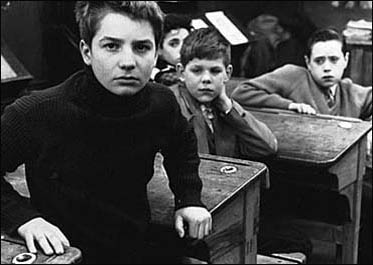
So why is 400 Blows high on that list for me? I was 17 and visiting Williams College with a friend who desperately wanted to go there (I already knew I was headed somewhere else, but went with him so I could miss a stultifying day or two of high school). One night during the visit we went to a film class, and the professor screened the movie for his students — I remember lots of turtleneck sweaters. So, I was away from home, in a strange and charged environment, watching my first subtitled movie, and it just happened to be this intensely real family drama about a “normal” kid and his “normal” family, and it all started spinning out of control for the kid, headed toward some conclusion that I feared more with every minute. I didn’t know you were allowed to make a movie like this. I was furious that no one had ever shown it to me before (the same feeling I had later when I first read Their Eyes Were Watching God). I couldn’t keep my mouth shut when the discussion period started, and even though it was January and freezing in Williamstown, Mass., my brain was on fire when I left. I wanted to know how to talk about things like this (I still do!).

And that’s how you get on that list. So what would be my top 3 movies in this category?

1. 400 Blows
2. From Russia with Love: Right on the edge of puberty, I got a blast of adult sexuality combined with some spectacular violence (for those days), a few bad puns, a fight to the death (or “to the pain”) between two gypsy women and some Cold War politics all rolled into one. My circuits overloaded big-time.
3. Blade Runner: Welcome to my brainpan Philip K. Dick, just in the nick of time to save me from death by lack of imagination.

That third slot is the one that changes with the tides of memory the most. Sometimes, I think that Blade Runner is just one of my favorites, not really a “havoc” movie. Then I’m tempted to toss Dr. Zhivago in there, because, well, Julie Christie and the sweep of it all and the music (and again I was at an impressionable age). Or maybe Raise the Red Lantern. Or possibly She’s Gotta Have It. I could go on…

… but I won’t because that’s not the point! The point is, I want to know YOUR “top three movies that have created the most positive havoc in my life.” Want to play?

25 comments »

  1. I’ll have to give more thought to numbers two and three (which shift), but the film that always pops to the top for me is Sergio Leone’s “The Good the Bad and the Ugly.” I was 11 and went to a matinee with a couple of friends and no parents. Highlights include: Ennio Morricone’s magnificent score; Eli Wallach’S over-the-top performance played against Eastwood’s taciturn mien; the gritty, dusty art direction; the brilliant editing; and the not-so-subtle antiwar sentiment that seemed particularly cogent in 1968. For anyone who hasn’t seen it, get past any notions you might have about Spaghetti Westerns and watch it as a great work of cinema.

    Comment by MightyToyCannon — August 10, 2008 @ 11:10 pm

  2. No parents! I posed this question to a friend, who immediately said, “The Graduate, of course!” Which I totally understood, except that I had seen it with my parents, which robbed the experience of some of its power. And The Good the Bad and the Ugly”? I still remember those torture scenes and shiver…

    Comment by barry — August 11, 2008 @ 5:47 am

  3. 1) “Chinatown” was the first movie that I saw with my dad that he didn’t care for and I did. He was an enormous influence on my interest in film and in shaping my taste, but this picture, which we saw when I was about 13, was a key rift between us and a signal moment in my own evolving sense of an aesthetic.

    2) “Duck Soup”: I’m guessing this was more or less that same year. Afternoon in the Jr. HS auditorium; film club screening of a wretched 16mm print. I was sat in the middle of an aisle among my friends, and during the big ‘off to war’ production number I was laughing so hard that I had to stand up and get out of the seats so I could *literally* ROLL IN THE AISLE. I’m still not sure I’ve ever had so much pleasure again doing anything. Anything.

    3)”The Road Warrior” I saw the first show of this at the Ritz Theater in Philadelphia, the Society Hill multiplex that served the city as the KOIN and Fox Tower have Portland: arty mainstream stuff playing to well-to-do white couples. I was utterly blown away and came home and told my roommates about it. We decided to see a matinee the next day in a central city SamEric theater: a kung fu/action house catering mainly to young black males. It was amazing to see how the film affected each audience so viscerally, creeping beneath superficial differences to grab everyone in both theaters and hold them for the duration.

    Other possibilites, also from those school days: “Blow-Up,” “The Stunt Man,” “Blade Runner,” “The Deer Hunter,” “Apocalypse Now,” “Last Year at Marienbad.”

    Since I’ve become a professional movie guy, I can think of only four films with this degree of impact on me. In chronological order they are “Goodfellas,” “Pulp Fiction,” “Saving Private Ryan” and “Waking Life.”

    I don’t know if this means that I’m more jaded or that I’ve seen it all or what. I suspect both and more.

    Comment by Shawn — August 11, 2008 @ 7:28 am

  4. I don’t know what my parents were thinking, but it was a day and age when a kid could pedal off on his bicycle and be gone all day long without anyone worrying. The torture scenes in “The Good, the Bad and the Ugly” are certainly cringe-worthy. But, counter those horrors with the scene in which Blondie (Eastwood) holds his cheroot to the lips of a dying soldier–truly one of the most quietly powerful acts of kindness in cinema.

    Comment by MightyToyCannon — August 11, 2008 @ 8:47 am

  5. “To Kill A Mockingbird” stands out for me. It’s crisp, dramatic, cinematically correct black and white photography is such a part of this film. The stoic, courageous Atticus Finch as father and community leader are lessons to all. The superb cast brings it all together. How would this story play out today? What differences would there be? See this film again… or for the first time.

    Comment by Marita — August 11, 2008 @ 12:12 pm

  6. Speaking as a movie geek who spent massive portions of her formative years either sitting in the dark in theaters, staring at the TV when old movies were on, or devouring film history books, my first thought is: only three! Only three movies that rocked my world?
    But, I’ll play:

    1) “Bonnie and Clyde”: Yes, I saw this with my mom. Good old mom. She took me to see this at the old, now-gone Esquire theater in Northwest Portland (right around the same time she took me to see “The Graduate” at Cinema 21). From the eerie, quiet beginning on those dusty small-town streets (and Warren Beatty changing Faye Dunaway’s hairdo at the cafe) straight on through to the bloody climax, I was hypnotized. Half of what I was seeing went over my youthful head (the er, sexual dynamics of Bonnie and Clyde’s relationship, for example) but one thing I knew: even with all my movie consumption, I had never seen anything like this. The mix of comedy and drama, the violence, the characters who swerved from likable to awful in an eye-blink, the evocation of the Depression, and the tension between these romantic outlaws and their grungy little lives — I was enthralled, amazed at all the things a movie could do.

    2) “On the Waterfront”: This was a late-night, me-on-the-couch-in-the-living-room discovery. I’d read about the movie, and then it showed up on — as hazy, probably incorrect memory has it — after the late-night news Sunday night on Channel 2. I seem to recall the station showing old movies then, and I know everyone else had gone to bed. Meanwhile, I stayed up, amazed at what Marlon Brando was doing. At first, I thought — but he’s mumbling, and the character is such a lump, why is this performance so famous? Then, I thought: this is the best performance I’ve ever seen (me, in my vast junior high school-kid experience). The other actors in the movie are good, but still stagy in that old-Hollywood, or old-theater way. Brando was so new, so different, so alive. And every time I see the movie again, he still is.

    3) “East of Eden”: While the movie’s a bit of an overwrought Elia Kazan epic, there’s a scene that filled me with euphoria. It’s a brief moment that James Dean and Julie Harris share on a ferris wheel — he’s tortured, she’s tender, and aaaahhhh…Well, the intimacy of the scene amid the general sturm und drang made me sit up and take notice. And wish it was me up on that ferris wheel.

    Comment by Kristi! — August 11, 2008 @ 1:22 pm

  7. Now we’re getting somewhere:

    Toy Cannon: a great scene with the cheroot! I also like how the armies disperse after the bridge is blown…

    Shawn: a real movie critic’s in the house! Duck Soup, yes, but lots of Marx Bros. movies, too. When I come to think of it, I was probably undervaluing the comedies in my life (possibly to conceal my love for Abbott and Costello…)

    Marita: So many great moments in To Kill a Mockingbird, and Gregory Peck as the world’s greatest father figure.

    Kristi: I bet you did wish you were on that ferris wheel in place of Julie Harris (who was just about perfect in the role, really, though it’s hard to think about her with James Dean on board).

    Comment by Barry Johnson — August 11, 2008 @ 1:57 pm

  8. There’s a theme-developing here: In loco parentis or, just plain loco parentis — parents letting us see things at strange, impressionable ages.
    This is my case. Two examples:
    1) Fantasia. I had to have been just a guppy when I saw this, barely breathing, because I vividly recall seeing it in the theater and according to my best internets sluething, this was likely when it was once again re-released, around 1977. They say early childhood is a critical period in brain development. If so, then my 4-year-old synapses were firing to Centaurettes! (Bare breasts!) An army of marching brooms! Dinosaurs fighting and dying to The Rite of Spring!
    2) 2001: A Space Odyssey. My dad took me to an arthouse revival when I was still a very little girl. For a long time I had no real ability to describe what I had seen, just fragments of images floating around in my head, like that fetus drifting in space. The ape-like creatures, their screeching. HAL’s gentle menacing voice….One day giant television screens appeared outside the elevators in the place where I work. They are tall and rectangular and broadcast the news of the day. I call them The Monoliths and resist the urge to screech … But I digress. My point is that all these years later, I love my father so much for showing me at such a young age that there is endless, wild, unsettling territory for us to explore. It does not need to make sense. Not right away. We just need to watch. And wait.
    Sounds like we have a lot of parents out there to thank for letting us watch…

    Comment by Inara — August 11, 2008 @ 3:17 pm

  9. I’m bad at this kind of game.

    1) James Benning - One Way Boogie Woogie: Saw it at Walker Art Museum while visiting a girl in Minneapolis. It was exactly the kind of film I always wanted to make and made a big impact on my senior thesis film. Too bad it’s impossible to see his work unless he’s presenting it, because I love all the films of his that I have seen.

    2) D.A. Pennebaker - Don’t Look Back: This, combined with the Maysles films also encouraged me in the direction I wanted to go in, ie LESS B.S., more REAL STUFF.

    3) David Lynch - Fire Walk With Me: Certainly not his best, but it was the first thing I saw by him (I was too young for Twin Peaks on TV) and made me a huge fan and opened the wider world of experimental film for me at a young age.

    Comment by dalas v — August 11, 2008 @ 3:51 pm

  10. Oh, the list shifts and shifts, and determining which films created havoc and which I merely loved might be beyond my diminishing capabilities. But:
    1. A category, not a single film: the great old silent comedies. I became aware of them when I was maybe 8 or 9. The local high school staged an annual fall carnival as a fund-raiser, and one of the attractions, which took place in the band room (yes, schools had bands in those days) was the screening on a stretched-out sheet of old one- and two-reelers. I remember Harold Lloyd hanging from the clock, and Laurel and Hardy fumbling their way through odd jobs, and The Little Tramp’s hapless infatuations, and W.C. Fields opening the arctic door to a splattering of snowflakes. And I remember my mother, sitting next to me, laughing in a way I’d never realized she could laugh: whole-heartedly, earth-shakingly, transcending herself, piercing, sobbing, roaring with delight. And I realized: Adults can be children, too; and children can be adults.
    2. A pairing: Marcel Carne’s “Children of Paradise” and Jean Cocteau’s “Beauty and the Beast,” the twin towers of French cinematic romanticism, both made or conceived in the deeps of France’s World War II self-occupation and both of which I encountered in my late teens. These movies brilliantly illuminated my own explorations into the possibilities of beauty, and each in its own way suggested the timelessness of that search. I still think of “Beauty and the Beast” as the most nearly perfect film I’ve ever experienced.
    3. Much as I regret not listing one of the great screwball comedies (”Twentieth Century” or “It Happened One Night” or “The Philadelphia Story” or “Arsenic and Old Lace,” if only for the scenes of Teddy Roosevelt charging up the staircase) or Les Blank’s “Garlic Is as Good as 10 Mothers” or one of Rainer Werner Fassbinder’s potently satirical and jumpy explorations of Germany’s selling of its own soul (with the glorious Hannah Schygulla) or the pure visual gobsmacking of “Days of Heaven” or the first half of “The Black Stallion,” I’m voting for “Bull Durham,” partly because it ticks me off that nobody ever puts it on their list of favorites and partly because Laura and I saw it on our honeymoon, and it’s become our reference movie, the one we quote to each other the way other people quote “The Godfather.” Sex and baseball and the beauty of the Thing Just Missed, in one glorious package, and a great soundtrack to boot: What could be better?

    Comment by Bob Hicks — August 12, 2008 @ 11:50 am

  11. After more thought, I’ve settled on Influential Film Number #2: Harold and Maude.

    I was a freshman at San Francisco State when I enrolled in a film appreciation course chock-full of great classics: Citizen Kane, The Big Sleep, Casablanca, La Dolce Vita, North by Northwest, etc. I was jazzed. The next semester I signed up for “Avant Garde Cinema.” While I felt bohemian, I was stumped by a language (verbal and visual) that I struggled to understand. I found refuge in a local art house that featured cheap double features. Harold and Maude was paired with King of Hearts. (Suggestion for a future blog topic: Memorable double features).

    I was tickled and charmed by the amalgam of quirky characters, incongruous romance, dry humor, dark undertones, poignancy, and life-affirming messages–-and the fact that one film could hold them all. I still well up when I watch Harold race his Jaguar/hearse across the Marin Headlands and over the cliff … and then the banjo starts playing and Cat Stevens starts singing, “If you want to sing out, sing out.”

    I’ve heard that Wes Anderson was a fan of Harold and Maude, and the influence is obvious in Rushmore and The Royal Tenenbaums. Which brings to mind my own parental role in introducing children to films: I watched Anderson’s first feature film, Bottle Rocket, with my two kids when they were probably 10 and 13. Afterwards, we had a heated debate about its merits. They complained that it lacked character development. I argued that character development was pretty much the whole shootin’ match–-without the oddball characters it wasn’t much more than a botched heist story. (I also argued that I was a grown-up who once took a film appreciation class). In retrospect, I suppose they meant that the characters didn’t go anywhere—they had no arc. I think that’s true and is what made it great film. At the end, Owen Wilson’s character flashes a killer grin that tells you he’s already working on the next scheme–no lessons learned there.

    Comment by MightyToyCannon — August 12, 2008 @ 10:46 pm

  12. Hmmm… I feel a little derivative, but I swear I came up with these before I read the comments:
    1 - Jean Cocteau’s Beauty and the Beast (although ask me on the right day and it might be Orpheus; I just don’t think anyone can even come close to Cocteau, visually): too beautiful for words, and with a psychological portrayal of the beast that doesn’t leave the bad taste of glorified domestic violence in your mouth. Had I not heard the Phillip Glass accompaniment before seeing the movie (recorded), this might not have made the top spot, but at the time, the idea that someone could interpret a film in a different medium was mind-blowing (come to think of it, that kind of puts it in category three, too, doesn’t it?)
    2 - There are so many: The Princess Bride for being all the right types of movie rolled into one; Arsenic and Old Lace (seconded) for Teddy Roosevelt trumpeting on the stairs; Tim Burton’s Sleepy Hollow for the chill factor that M. Night Shyamalan only wishes he could conjure (maybe the whole Burton gothic oeuvre, it depends on the day - there really is something sweet and shivery about Edward Scissorhands, isn’t there?); Lucio Fulci’s Zombie and Dario Argento’s recently-completed Three Mothers trilogy for being completely over the top in every possible way, as well as sheer gut-munch horror; The Devil’s Backbone for a far darker sort of chill, as well as beautiful cinematography; the three original Star Wars movies and the Indiana Jones movies for just being ripping good yarns. Oh, excuse me, I think my genre’s showing.
    3 - A tie between Raise the Red Lantern and Monty Python’s Holy Grail: the former because it showed me how creating an underclass withers the soul; the latter for honing my sense of the absurd.

    Comment by Sarah — August 13, 2008 @ 6:39 am

  13. Yes! “The Princess Bride” of course! For me, it restored the fairy tale on film as an exciting enterprise, though I’m always sorry when Wally Shawn succumbs to the iocaine powder (however you spell it), because I want to see more of him! And that’s the best of reasons to include “Bull Durham,” Mr. Bob. And I love the argument with the kids: “Look, I took film appreciation class in college!” Just wonderful. Thanks!

    Comment by Barry Johnson — August 13, 2008 @ 7:32 am

  14. Man, this is a high-minded list of films ahead of me. I’m abashed at how outre my own list is, but amused to see that some of the movies that have moved me the most are……not very good. Technically, I mean, not to mention matters of craft. But here goes, in no special order:

    1. Outrageous. This is the old indie flick starring Craig Russell and Hollis MacLaren. I forget the director. Saw this one in 1977 at an ancient art house in the downtown — maybe it was called The Movie House? Anyway, this is a low-budget period piece about a drag queen and his mentally disturbed best friend, both of whom hate themselves and both of which gradually come to accept who they are through their mutual interdependence. It has one of my favorite lines in all of cinema: “You’re not dead! You’re alive and crazy and living in New York City like eight billion other people!” At the time, all this meant a lot to a young man too shy to say his name without stuttering.

    2. Shock Treatment, allegedly Richard O’Brien’s sequel to The Rocky Horror Picture Show but in fact having almost nothing to do with the original. Another low-budget cult film with gobsmackingly susbstandard production values, you really have to stick with it, because for most of the movie, you will not know what’s going on. Ultimately it turns out to be about a town full of people so unwilling to think for themselves that they enthusiastically submit to imprisonment in mainstream media — except for four mavericks who escape conformity(one of which was played by Ruby Wax!).

    3. Resurrection. Yes, the ancient Ellen Burstyn vehicle. Just because I desperatley want to believe in the cosmic integument it posits.

    Comment by MrMead — August 14, 2008 @ 10:04 pm

  15. MrMead, The Movie House, yes! The same Seattle company owned the Movie House, Cinema 21 and the Fine Arts (now CineMagic), and the Movie House was sort of the flagship. Anyway, I think you’re onto something — the key here is impressionability more than movie-making genius, the subject apprehending more than the piece of art. A friend at work and his wife immediately cited “The Shootist” when I posed the question to them. He had just gotten out of grad school and was teaching one class in one Cal State or another; she was just about done with school; they were recently married, no money, no particular prospects. And they wander into “The Shootist”(which actually IS a good movie, in its way), and somehow when John Wayne delivers the creed of his character, JB Books, that just meant EVERYTHING to them: “I won’t be wronged, I won’t be insulted, and I won’t be laid a hand on. I don’t do these things to other people, and I require the same from them.” My friend recited it exactly (which actually he can do with LOTS of lines) as though it were 1976 (or so) all over again. Anyway, cool list!

    Comment by barry — August 15, 2008 @ 5:21 am

  16. WHAT? Nobody lists The Red Shoes? Shame, shame. I saw it seven times when I was 13 and it was revived in a theater in the Village (not East, not West, thank you very much, but The Village) the first time as a way to beat the unspeakable heat and the next six because I couldn’t stay away. Michael Powell set the standard for filming dance in that movie, as early as 1938.
    I too would include Beauty and the Beast, and probably all of Fellini, and Jimmy Stewart Westerns I saw with my father on Saturday afternoons, and Gene Kelly musicals. Chaplin’s The Gold Rush, etc. etc.
    So there, from the dance critic.

    Comment by Martha Ullman West — August 15, 2008 @ 12:06 pm

  17. See, you lived in the Village and they showed movies like The Red Shoes not to mention Fellini! Now, the Jimmy Stewart Westerns, that’s where we intersect! The choreography of the double take!

    Comment by Barry Johnson — August 15, 2008 @ 8:47 pm

  18. Memorable too was a day when I was walking home from school (age 12) and ran into my dad on 8th Street, headed for the Art Theater (yup that’s what it was called) to see a matinee of Menotti’s The Medium, so I tagged along and learned that opera can be very compelling on film. Some choreography there too.

    Comment by Martha Ullman West — August 16, 2008 @ 9:26 am

  19. I remember two mind blowers.

    1) While visiting family friends, movie people in west hollywood, and after the 6th, 7th, or 10th viewing of “The Producers” in that household, in my lifetime, someone suggested we watch “Man with a Movie Camera.” I was young enough to not have seen anything experimental, at least not with an understanding of experimentation. The people responsible for introducing me to art had failed, up to that point, to note how neat everyday life can look on film. I was impressed.

    2) “Cinema Paradiso” had me rethinking not how movies are made but how movies are watched. It is still representative of my favorite sort of film; sweet, family stories, starring adorable kids, filmed elsewhere. I was mostly in awe of movie theaters filled with swearing, drinking, smoking Italians. Where and how can I experience movies like that? As an event with full audience participation. I don’t mean those annoying popcorn munching, gum chewing, cell phone talking, snide comment making american movie viewers. I want fully engaged and enraged Italians. Ok, they could be Greek or French.

    Comment by rachael — August 19, 2008 @ 7:03 pm

  20. This strand may have played itself out, but I still “owe” a third movie that rocked my socks. Barry’s recent post about the new Woody Allen flick prompted a fond memory of “Take the Money and Run” (1969). Besides being packed with indelible gags, Woody’s parody of the documentary form was, for me, the pioneer of great ones that followed–from “Spinal Tap” to the brilliant send-ups of the media found nightly on the Daily Show and Colbert Report. Are there earlier examples of “mockumentaries” that I don’t know about?

    And, while I’m at it, let me concur with an earlier post on Cocteau’s “Beauty and the Beast.” I tagged along with my older sister and her totally hip, artistic boyfriend to see it at a San Francisco “art house.” I had no clue what I was in for, and it felt a little bit illicit, like entering an opium den. I think I spotted Jerry Garcia in the audience, though it might have been Francis Ford Coppola.

    Comment by MightyToyCannon — August 20, 2008 @ 11:18 am

  21. This thread may never die! Rachael’s comment suggests another topic — movies that feature movie audiences in important roles, the most recent great example I can think of is in “O Brother Where Art Thou”: “We thought you was a toad!” Delmar yells in a movie-theater hushed voice to Pete. But yes “Cinema Paradiso”! And another topic from Toy Cannon: the birth of the mockumentary. We’ll have to get Shawn back into the thread to figure that one out, I bet…

    Comment by Barry Johnson — August 20, 2008 @ 11:37 am

  22. I’m late to this game, not sure if it’s just movies that moved us but also have a bit of guilty pleasure attached to them, but here I go:

    1. “Grand Canyon.” something about this Kasdan film totally got to me, and the tone of it stayed with me for days after. It’s one of the few movies I actually own, not being someone who buys DVDs. Maybe it’s partly because I was born and partly raised in L.A., but that film never fails to move me in a real way. Just love it.

    2. “Holiday.” Probably not the most famous Hepburn/Grant movie, most people love “Bringing up Baby” more, but I watch this movie at least once a year, sometimes more. And truth be told, it’s for Edward Everett Horton. I have a HUGE crush on him in this movie; seriously, you just want to wrap him up and take him home.

    3. “The Member of the Wedding.” Sorry, just makes me weep.

    Comment by cynthia fuhrman — August 24, 2008 @ 9:17 pm

  23. [...] The Red Shoes, which Friend of Art Scatter First Class Martha Ullman West has recently promoted as one of the greatest movies of all time. If you’ve done what we often do on holiday weekends and let your newspaper sit untouched, do [...]

    Pingback by Art Scatter » Pre-Labor Day Scatter: Red shoes, hot peppers, art scams — August 31, 2008 @ 8:49 pm

  24. I know, I’m late to the party.

    I agree with Bob about “Bull Durham.” The rose goes in front, big guy. And, Kristi, say it with me: “Candlesticks make a nice wedding gift.”

    The movie that moved me? “The Harder They Come” with Jimmy Cliff. My brother hauled me to it when I was an impressionable teen. Yep, sans parents. The heart-pounding reggae, the thick pot smoke, the tender and raunchy sex, the gun-blazing defiance against compromise at any cost that leads to self-destructive depravity. Could puberty have a better cultural touchstone?

    Comment by Laura — September 1, 2008 @ 8:52 am

  25. Nice site you have

    Comment by Jeryyms — October 25, 2008 @ 9:32 am

Copy link for RSS feed for comments on this post or for TrackBack URI

Leave a comment

Line and paragraph breaks automatic, e-mail address never displayed, HTML allowed: <a href="" title=""> <abbr title=""> <acronym title=""> <b> <blockquote cite=""> <cite> <code> <del datetime=""> <em> <i> <q cite=""> <strike> <strong>

(required)

(required)