By BOB HICKS
In Paris they were called abonnes.
In Moscow and St. Petersburg they were balletomanes.
Lincoln Kirstein, the impresario who founded New York City Ballet with George Balanchine, rolled his eyes and referred to them waspishly as “balletptomaines.”
One way or another, they are nuts: nuts for the ballet, for the dancers, for the social swirl, the easy access. The ones who know every step, and know better than the choreographers how the steps ought to be combined. The ones who give money to the company and assume they’ve bought the right to make decisions about how it’s run. The starstruck, the shoulder-rubbers, the bedazzled. The gents who love the bodies — in an entirely aesthetic sense, of course. The best friends a ballet company can have, and a bane on its existence.
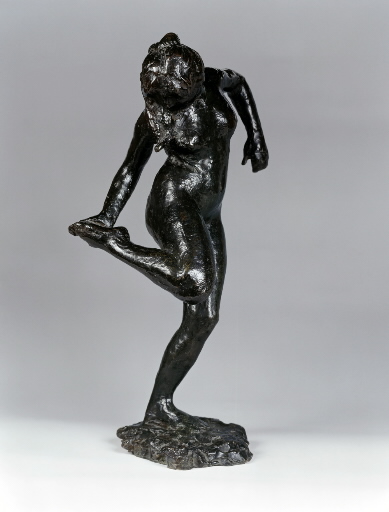
The Portland Art Museum’s current exhibition “The Dancer: Degas, Forain, and Toulouse-Lautrec,” which continues through May 11, 2008, gives an almost unseemly amount of attention to the abonnes, those wealthy and well-connected Parisian gentlemen of the late 19th and early 20th centuries who, by virtue of their season subscriptions to the Paris Opera and other performance halls, had unprecedented access to the backstage life. Some of Degas’ prints in the exhibition touch on the subject, but they are the compulsion of Forain and to a certain extent the exhibit as a whole, throwing the thing into a curious imbalance: Forain, by far the least important of these three artists, becomes the defining figure in the show.
The imbalance is less noticeable as you walk through the galleries than it is in the exhibition’s handsome catalog, which emphasizes the predatory nature of the abonnes — or at least some of them. You get little sense of proportion; of the probability that, while some abonnes cruised backstage on the prowl for one-night stands or longer-term assignations, many others were simply harmlessly in love with the scene.
Forain was a social satirist and a caricaturist of some skill: On his best days he approached the merciless insight of the much better artist Honore Daumier. In his many drawings of the backstage scene, which range from moments of light tomfoolery to scenes of moral debasement, Forain emphasized the corruption of the abonnes, and by extension the whole damned enterprise. The wealthy, usually old and corpulent men make passes at the young and poverty-entrenched dancers. Sometimes the dancers’ mothers, as seedy-looking and sunken in fat as the wealthy “protectors,” barter their daughters’ favors in exchange for a little money for the family. The message is reductive: the men are abusers, the dancers are whores, the mothers are pimps. And the band plays on.
It was, of course, a time and place where the rich were very rich and the poor were very poor (sound familiar?), and there is no doubt that in many cases Forain’s analysis was spot-on. With wealth comes power, and with power comes abuse. But it was a popular image, too: One of the reasons Forain repeated it so often is that his little scenes of corruption sold like hotcakes. But this singular fascination denied some larger truths about life at the ballet and its more rakish cousin performances at the Moulin Rouge — truths that Degas and Toulouse-Lautrec celebrated.
Degas’ prints and sculptures (and a smattering of oils) emphasize the skill and hard work of the dancers: They dignify the dance as a genuine and demanding art. If a certain coolness attaches to his drawings and paintings, it’s because he was for the most part a detached observer, fixated on the form and formality of the human body as exemplified in these talented aesthetic athletes. (He found the same sort of cool dignity in his washerwomen and bathers.)
My favorite section of “The Dancer” is Toulouse-Lautrec’s. There are technical reasons for that: He was in the vanguard of a revolution in printmaking, and made some remarkably sophisticated decisions about how a print or poster could look. But mostly I love his work because it reveals how much he loved show life and how much he was a part of it. He wasn’t tut-tutting like Forain, or using the world of dance to explore a formal aesthetic like Degas. He was recording the world he lived in and loved: the show, the people, the gaudiness, the dazzle. He didn’t need a theory to portray such remarkable performers as Jane Avril and the acrobat Choo-U-Kao with insight and sympathy: They were his companions and fellow artists. He painted his world from the inside out, and that made all the difference.
One remarkable set of four prints by Toulouse-Lautrec, by the way, has more than passing local interest. The 1893 prints, in varying shades, capture the giddy inventiveness of the American-born dancer Loie Fuller, whose dances turned a swirl of billowing cloth into a mesmerization of kinetics. Toulouse-Lautrec’s prints reimagine the vivid freeness of Fuller’s celebrated dances with impressionistic clarity. Years later Fuller would become one of the guiding inspirations for the transformation of her friend Sam Hill’s fortress on a desert hilltop above the Columbia Gorge into the Maryhill Museum of Art, 100 miles east of Portland — and that’s another story altogether.
Meanwhile, back at the abonne ranch: Yes, they’re still with us. Always have been, always will be. Rank has its privilege, whether it’s fair or not, and arts organizations will always be to an extent at the beck and call of their benefactors. One of the most important jobs of any museum director is to shamelessly flatter wealthy and impressionable and often autocratic potential donors. The history of American museums is littered with stories of directors and senior curators being led around by the nose by some wealthy matron or another eager to show off her ability to — well, to lead a museum director or senior curator around by the nose. Companies offer special “opportunities” — anyone remember a certain car dealer and ballet donor cavorting onstage with Oregon Ballet Theatre a few years ago in “The Nutcracker”?
Not everything about the balletomane or museum patron or theater nut is ugly. Every arts organization needs its passionate followers, the ones who truly care. Most balletomanes are balletomanes simply because they truly love the dance. Sure, they can be exasperating (and, yes, sometimes they can be romantically fixated on a specific performer). But sometimes they know things, too. And sometimes they unzip their wallets and write hefty checks that make things like “The Dancer: Degas, Forain, and Toulouse-Lautrec” possible.
Pingback: Google against Forain - Wallpapers HD()