Here’s what I think. I think we think too much.
Sometimes.
About art.
 About visual art, definitely. We’ve created a mumbo-jumbo priesthood of commentary and pretend the intellectual abstraction is more important than the physical experience of the art itself. Which it is, but only sometimes. And far less often than the priesthood likes to think.
Also about dance, which on the face of it is about as physical and sensual as an art form can be: One’s body is one’s art. That doesn’t mean dance isn’t driven by ideas, from folk styles to ballet and modern and the most contemporary expression. Yet in no other art form is it so literally true that an artist creates a body of work.
On Friday night Portland was happily busting the spine of an unPortland-like heat wave, but the word hadn’t drifted up to the fourth floor of downtown’s Pythian Building, where giant fans were whooshing to keep the sticky air circulating at Conduit Dance. Conduit’s in a bit of a pickle financially right now, and so it’s putting on a series of benefit performances this weekend and next, and Friday was opening night.
A hot and sticky affair, as it turned out: For a change, the audience got a feel for what it’s like to be out on the floorboards, sweating under the lights. Because so much of the audience was made up of dance people, anyway, it just helped to create a here-we-are-together mood. And because the wet heat had the mildly giddy effect of a low-grade fever, it encouraged dispensing with analysis and just experiencing the thing. As Paul McCartney put it, Let it be.
For years I’ve watched Linda Austin, a smart and funny woman who’s established herself as one of the city’s leading contemporary performers, and for years I just haven’t quite got what she’s up to. Linda’s out there, and I’ve spent a bit of time trying to figure out where “there” is and exactly why she’s taking us to it. In that suss-out-the-puzzle sense her Friday night performance, a solo study for her work-in-progress Bandage a Knife, was pretty familiar in its unfamiliarity: Who besides Linda knows what that chanting and waving of lights was all about?
But under the spell of the evening I realized I didn’t care. What it meant wasn’t important. It just was. And with that liberating realization I settled back and enjoyed a sophisticated, funny, well-shaped performance that didn’t need to be parsed and psychoanalyzed. There was more than just light comedy to this piece — it managed somehow to be extroverted and introspective at the same time — but a couple of times I laughed out loud.
Once I shed the compulsion to understand I was left with some valuable things I’d been overlooking, or at least underappreciating. Austin has a mime’s sense of her audience, a silent comedian’s mastery of gesture and effect. She has marvelous control of her body, pushing it to the edge of awkwardness and imbalance and then pulling it back, like a wobbling toy top that gets a fresh spin. And as esoteric as her work can be — it’s just not for everyone, and there’s nothing wrong with that — she is always, always aware of her audience. Austin doesn’t just let it hang out. She performs.
That subtle sense of creating ground rules — of saying, this is a performance, and I am the performer — is part of what separates professionals from amateurs. (Yes, there are exceptions. But not many.) I sensed it in the deceptively casual work of Benjamin Ford Asriel, a lean and twisty young dancer whose piece, an excerpt from We Have Become Beautiful, is an exercise in spinning, from various positions and at various speeds. He has a way of twisting his torso from his narrow hips that brings to mind the way you can twist a rope of wet clay so it takes on the coiled look of a spring, narrowing and lengthening in the process. This is the first time I’ve seen Asriel perform, and I’m intrigued to see where else his dancing takes him beyond these liquid variations on a narrowly focused theme.
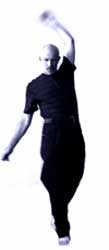 The always graceful and often whimsical Gregg Bielemeier‘s new piece, Tracings (part 5) made me think of a very different choreographer, Trisha Brown — not for any particular similarities in their styles but for the idea of passing things down. All choreographers to a certain degree base their work on the way their own bodies move, and Bielemeier’s aesthetic sense, like Brown’s, has always seemed to me particularly attuned to the ways his own body “thinks.”
So it was fascinating in Tracings to see a young dancer, Taylor Young, doing the kinds of specifically idiosyncratic things with his body that we’re used to seeing Bielemeier do with his own. Young’s part of the dance was choreographed. Then Bielemeier stepped on stage and began to improvise, echoing and responding to the work he’d already created on Young. Which was the “real” Bielemeier? Well, Bielemeier’s improvisations seemed the smoother, more natural fit — but maybe simply because that’s where we’re used to seeing this particular combination of physical expression.
And that made me think of the ways that mature dancers pass along the knowledge of their muscles and bones when they reach the point that they no longer perform themselves. That’s a point Bielemeier most definitely hasn’t reached yet. He’s still wonderful to see, and in a way more interesting as he ages, smarter and more proficient, with less wasted energy. He defies the convention of dancing as a young persons’ racket and helps you realize it can be a life-long process.
Still, for most dance makers, a time comes. Over the years I’ve watched Brown’s company when she performed with it and after she’d retired from the stage, and the differences are subtle but real: Nobody knows her body, and therefore her choreography, as well as Brown herself.
 Far too much contemporary art is afraid of emotion, which means it’s afraid of humanness itself. Don’t dip in: The water’s cold and deep. One of the things I love most about Josie Moseley is that she embraces emotion, without even thinking of apologizing for it. She tells meaningful stories, and she tells them largely, with the precision and even delicacy of a miniaturist but with an operatic scale. She creates her patterns to music that goes places, and she knows how to overstuff a small space like Conduit with dramatic bigness that will land in the audience’s lap. The reason this doesn’t turn out like Ethel Merman blaring in the spotlight is that Moseley has intelligence and restraint. Like a symphonic composer she knows how — and when — to build things up and let them drop down again.
Hold My Hand, Josie’s piece at Conduit, includes a solo by Oregon Ballet Theatre principal dancer Gavin Larsen (pictured) and a finely danced duet by Jonathan Krebs and Pamela James-Gooderow. It underscores a couple things I already knew: Larsen is a superb, elegantly balanced, dramatically engaged dancer; and Moseley’s dances should be seen a lot more often in a lot more places.
——————-
More Conduit tonight, Saturday — hit it if you can. And next weekend (Friday and Saturday, Aug. 7-8). Tickets here.