Music, maestro, please. But can’t you be a little nicer?

So much going on in town, so little time. So VERY little time, when you’re on the road.

TBA? For a lot of people in Portland, PICA’s orgy of the experimental and unusual is the biggest arts deal of the year. Looks like I won’t catch any of it. Which is why, Dear Reader, you won’t be reading about it here.
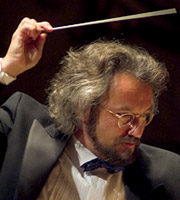
Carlos Kalmar/Oregon SymphonyThe symphony’s kicking into its season. So are the opera and the city’s theater companies. Ballet is getting ready to haul out the slippers. Across the city, tuxedos are coming out of mothballs (OK, that’s an exaggeration: This IS Portland) and uptown revelers are dusting off their dancing shoes.

Me? This morning I’m behind the wheel again, making like Willie Nelson as I head for far eastern Oregon and the Wallowa Mountains. If Heaven can wait, so can All My Sons.

Yes, the League of Tough-Guy Arts Observers is going to have to do without me for a spell.

Playing catch-up, I discover Bill Donahue’s intriguing profile in the current Portland Monthly of Carlos Kalmar, the Oregon Symphony’s conductor and musical director. I know Bill a little, and he’s not only a good guy but also one of the city’s most graceful writers. And he’s fearless. He admits right up front that he went into this story knowing next to nothing about classical music. Then he does his homework, and he does it well enough to write some gorgeous passages about life behind the scenes.

Trouble is, according to a lot of musicians, it’s tough to make up for a lifetime of neglect in such a short time. In short, they say, Bill didn’t know enough about the way orchestras work to be able to weigh his impressions adequately. They believe he misunderstands the complex relationship between conductor and musicians, and sees lots of controversy where little exists. True enough, a certain amount of ogre shows up in Bill’s depiction of the Big Bad Autocrat, although he also hints that all that aloofness and disdain might be just part of the maestro act.

Wherever you fall on this question, Bill’s story is a good read, and I recommend it — with this caveat: To balance it out, you should go to Daily Observations, symphony violist Charles Noble’s urbane and insightful music blog, to see how he and other musicians respond. The conversation — the dialectic, if you’re a Brechtian or a devotee of classical Greek philosophy — is sharp, and maybe by bouncing the two sides against each other you’ll find your own version of the truth. This is Noble’s main post on the controversy, and it includes a lot of reader comments worth your time.

Happy reading. I’m thinking about dusty roads and cowboy hats.

9 Responses to “Music, maestro, please. But can’t you be a little nicer?”

  1. curtis heikkinen Says:

    I am one of those who have commented over on Charles Noble’s web site. I am not a musician but I am season ticket holder for the symphony. I thought the Donahue article was well written and had an interesting perspective. However, I too felt it tried to create some controvery where none really existed. He cited one patron who complained about programming of a Bruckner symphony. Donahue should have gotten a greater sample. If I had been asked, he would have received a far different response. I like Kalmar’s programming a great deal. As far as I can see, the musicians have really responded to Kalmar’s leadership and have evolved into a fine orchestra. I wish Donahue’s article had focused more on the positive things that have occurred during Kalmar’s tenure.

  2. Art Scatter » Music, maestro, please. But can't you be a little nicer? super conductor Says:

    [...] See more here: Art Scatter » Music, maestro, please. But can't you be a little nicer? [...]

  3. Gregory Vajda Says:

    A good read? Does that make up for not being correct? I am sorry if you are serious about what you’re writing. Admitting that you don’t know anything about your subject is NOT PROFESSIONAL. It could be brave, cool, hip, even fun but NOT PROFESSIONAL! It is just a weak excuse, I am afraid. How do I know it? Read your own post’s last paragraph: Charles Noble is a VIOLA PLAYER! Not making that mistake would have qualified as professional!

  4. Bob Hicks Says:

    Hello Gregory, thanks for pointing out my bonehead mistake. (For readers who might not know Gregory Vajda, he’s the Oregon Symphony’s resident conductor.) Yes, I know Charles Noble is a violist; I’ve fixed the error in the post. (For the record: I originally called him a cellist.) I know it’s irritating to read a dumb error of fact in print, and I apologize. One of the problems with the blogging world is that it generally lacks copy editors, who are very good people to have around.

    In this case, I plead not ignorance, just one of those dumb moments of fingers not typing what brain tells them to type. I’d recently been talking with a symphony cellist on an entirely unrelated matter, and I guess cellos were lurking in my subconscious mind. I read Charles’s blog regularly and sometimes refer my own readers to it; he’s a smart guy and a good writer, and I appreciate his inside views. And I do know the members of the string family: I’m a long-ago bassist myself.

    As for the rest: I sling my share of opinions around, but in this case I was simply acting as a broker of information. Most of my readers were probably aware of Bill Donahue’s story in Portland Monthly. Fewer were probably aware of the reaction to it in the music community. A lot of that reaction is reflected in Charles’s posts in Daily Observations and the comments there. I wanted to draw people’s attention to that and bring the two stories together. I’m having a little trouble understanding how that’s a bad thing. Light, not heat.

    Yes, I think Bill’s story is a good read. He’s a fine stylist, and musicians ought to be able to recognize that. Do I agree with all of his conclusions? That’s another question entirely. (And, yes, he admitted his ignorance of classical music, but he didn’t brag about it: He also made it clear that he tried hard to learn what he didn’t know.) The crux of this controversy is over what he said, not how he said it. A lot of people think he didn’t report deeply (or widely) enough, and that because he didn’t know ENOUGH about the music world, he misinterpreted what he observed. That’s precisely what my own post reports: that Portland Monthly’s story has sparked objections, and here’s the crux of what they are; go to the original sites to learn more.

    I know a fair number of symphony players, and I hear a variety of things from them. Most of them support Carlos and Elaine Calder, often passionately — pretty amazing when you consider that everybody’s taking pay cuts. Do I sometimes hear grumblings? Yes. Having worked many years for a large organization, I understand that there is often a difference between letting off steam about your employer and the way you truly feel about your bosses. Most bitching is just that. Some of it reflects deep-seated frustrations and differences of opinion. One of the journalist’s most difficult tasks is to try to figure out from the outside which is which, and the task is often made more difficult by the secretiveness and internal assumptions of whatever group the journalist is writing about. Put it another way: Sometimes when journalists get it wrong, it’s because their sources didn’t help them get it right. I’m not saying that’s the case here. I don’t know, and I won’t presume. Another thing to think about: Did Mr. Donahue get things wrong, or did he simply come to conclusions that don’t coincide with your own beliefs? I happen to think there are some distortions in the story according to my own understanding of the symphony and Carlos’s role. That doesn’t mean I can’t learn something from the way Bill sees it.

    Giving your life over to classical music isn’t the easiest choice in the world. Musicians are highly specialized workers, and I understand the feeling that nobody but other musicians can possibly understand what it is that they do. I don’t presume to discuss music with my musician friends on a collegial basis, because I don’t understand it technically they way they do, and I’m far less familiar with the repertory. But musicians are also communicators. It’s the essence of what they do, and they are almost always communicating with people who have less knowledge than they do about music. Does that mean that nothing listeners have to say about what they hear is worth paying attention to unless it’s unalloyed enthusiasm?

    I think that, in this case, what musicians want is simply that their world be accurately and sympathetically understood. Fair enough. We all want that. I’ve been told by a conductor (not you; I don’t believe we’ve ever talked) that no one who is not a musician has a right to write about music, because they always get it wrong. That’s pretty extreme,and maybe even a little egomaniacal: It unfortunately feeds the stereotype of the arrogant conductor. Most musicians I’ve talked with take a precisely opposite approach: They are open and eager to talk about their music as long as they feel you are genuinely interested in hearing what they have to say.

    I understand how dismaying it must be to then feel that what you said has been misrepresented, even unintentionally. But I don’t believe the answer is to circle the wagons against the onslaught of the unwashed hordes. That can only further marginalize classical music at precisely the time that it needs to reach out. Don’t just rap knuckles; continue to communicate. Do you seriously believe that Bill Donahue’s goal was to do a hatchet job? Or even, if you read his piece dispassionately (not an easy thing when you’re in the middle of it, I know) that that’s how the average Portland Monthly reader is going to see it? Argue back, as Charles and others have on Daily Observations. Write a reasoned response in a letter to the magazine’s editor that sticks to the issues and doesn’t get personal. Make your best case. If your best case is misunderstood, regroup and communicate again. If anybody ever said it was going to be easy, they were wrong.

  5. Gregory Vajda Says:

    Hi Bob,
    that is exactly what I am trying to do, make my best case. I mostly agree with what you say in your comment. The real reason I am upset about is not the article itself. In my business you read many articles like that, well written, mostly factual with strong editorial touch ups. This is a long time concern of mine and I just can’t let it go. If you’re starting point is that you DON’T KNOW what you’re talking about is NOT PROFESSIONAL! Period. Seriously, would you write about astrophysics? I wouldn’t even publish anything without having someone whose first language is English read my stuff , exactly because I want to be as professional as possible and not only in music. (Sorry, this does not apply to blog posts. :))

    In any case, we can argue about things like: is this really an article that Portland Monthly should publish (that is of course up to the editor), does it really have an impact or is it only sensationalism (I think this is what bothers most of us, the statements without the knowledge or facts behind them.), couldn’t you find someone who’s at least on an amateur level is connected to classical music, etc. Again, this is NOT what I am angry about. It is strictly the UNPROFESSIONALISM of professionals and the way they are trying to sell it as something positive.
    Best regards
    Gregory

  6. Gregory Vajda Says:

    Bill,
    One more thing. You say: blogging world generally lacks copy editors. Yes, it is a fact, but blogs can be very different. I believe that if you are writing an art-blog with previews, reviews, sometime serious articles you need SOMEONE to catch big mistakes like the one you made in your post. Honesty, I as a reader don’t care that there’s no editor. All I care about is that printed words , as you very well pointed out, have power. With power comes responsibility. That is where I miss professionalism (this is NOT about your typo now!) and I get angry especially when I am told that it is OK not to be one (and by the author himself…)

  7. Bob Hicks Says:

    Thanks very much for expanding on your thoughts, Gregory. I think the arguments are well laid out now, and I think that’s good. — bob

  8. Gregory Vajda Says:

    Dear Bob, according to Barry Johnson’s article (blog.oregonlive.com) things got a little rambunctious here… I hope that you did not take my comments personally! I admit I get worked up over things when it concerns art and my art-form in particular. I hope it’s understandable! One more thing before I let this go, and this is now both to Bill Donahue and Barry Johnson. Could we, please, HELP Portlanders to understand the art-form of symphony better! We should help them together (us musicians and you, men of the words) because none of us can do it alone!
    Thank and all the best
    Gregory Vajda

  9. Bob Hicks Says:

    Hi Gregory,

    Nothing wrong with rambunctious! That’s how ideas come out — through a dialectic. I kind of like the word “kerfuffle,” but “rambunctious” will do fine. I think Barry’s summary of the whole situation was very good; glad he posted it and I hope it runs in print as well. There are lots of discussions to be had about how symphonic music is to thrive in the contemporary world, and how the Oregon Symphony in particular makes itself essential to its community. The uncomfortable truth is, it’s not enough to have an excellent product. The Symphony — all arts organizations — need to make a compelling case to the community that they are exciting, provocative and essential. That task may begin on the podium but it can’t stop there. What is it that makes THIS orchestra essential for THIS community? I know the organization things long and hard about this question. That process has to continue. And sometimes, it involves listening to a whole lot of what might seem off-the-wall ideas.

Leave a Reply

a Portland-centric arts and culture blog