We’ve been MIA on Suddenly the set of exhibitions, lectures and events exploring the shape of our cities through the lens, primarily, of German urban designer/theorist/architect Thomas Sieverts. But we did make it to Sieverts’ lecture and a panel discussion Friday afternoon at the UO’s new architecture school branch in the White Stag building in Portland’s Old Town, a suitably central (or maybe, paradoxically central) spot to consider the remaking of suburbs, I suppose.
 Matthew Stadler (a Scatter friend) did the introductions and moderated the panel, which was appropriate, because it was his reading of Sieverts’ book Cities Without Cities that suddenly changed his thinking about where the energy in cities really is these days and started this “movement” going. I think I’m getting ready to argue that Matthew’s was a creative misreading of Sieverts, though I’m waiting for one more event, another panel on Monday night, to confirm my first impressions, especially since I haven’t read the book(!).
Fairly early on in Sieverts’ lecture another friend of Scatter wondered about the intelligibility of his argument. But I think I understood the gist. The thought line he presented went something like this. 1) European cities are “splash” cities, meaning they no longer have compressed central cores. Instead, they sprawl a lot like American cities. In Sieverts’ powerpoint, charts and graphs showed just how “splashy” specific German cities had become. 2) The edges of this sprawl are chaotic and featureless. 3) German cities are shrinking in population, which makes it hard to change the edges through growth: It takes transformation. 4) Architects should address the problems of the edge, supplying aesthetic “meaning” and cultural coherence to them, even though planners tend to ignore them because they are so nondescript. 5) If these “edge cities” are going to compete in the global economy, they are going to have to attract “creatives” (Richard Florida’s young creatives, though Florida wasn’t mentioned), and that makes the transformation of these featureless suburbs, between spaces, crucial.
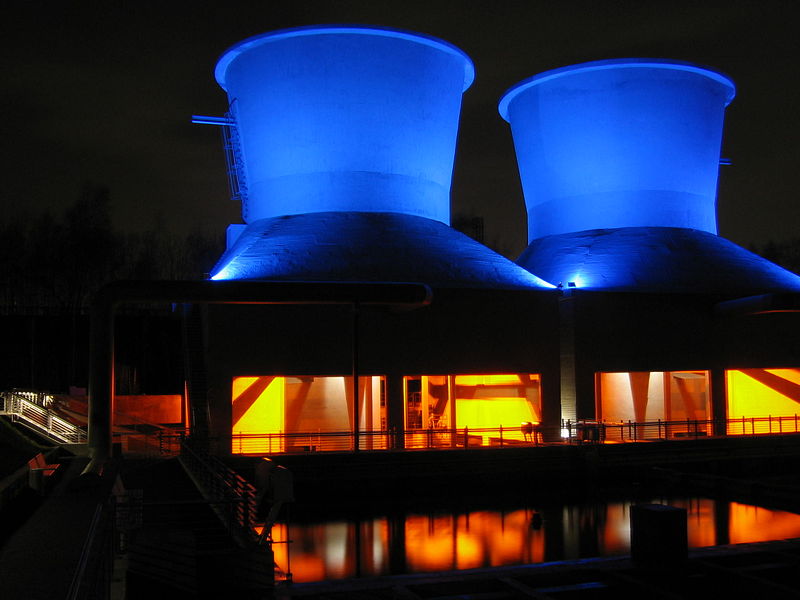
Sieverts, who was born in 1934 and has had an important career in architecture and planning, then showed some of his recent projects that attempted to bring “meaning” to the edges. In Luxembourg he emphasized a public campaign to help people see the edges as something other than ugly so they could appreciate possible changes. A Rhine River project to help alleviate flooding (since the 19th century, the Rhine has been channeled and the surrounding landscape drained for farming, with some catastrophic consequences) also depended on changing the thinking of the people around the project. Some more: Sieverts connected a standard issue Ikea site off an autobahn to a surrounding system of parks by making making its parking lot a public area and constructing pedestrian paths. And most beautifully and dramatically, Sieverts converted a massive steel plant into a park with bridges, water features and protection from the accumulation of pollutants (photos above and below). So yes, transformation by changing the “cultural meaning” of places on the edge.
 What were the takeaways? Most dramatically, that in Germany concern for the compact city center should be replaced by concern for the suburbs (neither Sieverts nor Stadler, if I remember correctly, used the word “suburb”), and that concern should be expressed in changing culture as much or more than changing the cityscape. The first part of this runs counter to our thinking about American cities, and especially Portland, where planners attempt to keep downtowns intact and often despair about their failure. What happens when you give up on central density and concentrate on “fixing” the featurelessness of the sprawl? Something like what Sieverts is trying to do, which he considers to be the rational response to conditions on the ground.
Or at least conditions on the ground in Germany. Because some American cities are growing, Portland among them. If our current population growth estimates are correct, we’ll be in a mash-up with something like another 1 million humans, at least, in the Portland metro area in the next 30 or 40 years. The conditions that generated sprawl in Germany have dissipated; they haven’t here. So perhaps our mantra of “density, density, density” still applies, and our efforts to make that density work should remain the central concern of planners. In Portland, efforts to direct growth outside the city core have already begun (with mixed results) and that growth, one way or another, will transform Lake Oswego, Beaverton, Hillsboro, Gresham, Vancouver, Wash., and the rest of Portland suburbs. The struggle for planners is to get ahead of it.
So, I think Sieverts’ prescription for Germany isn’t directly applicable here. But I am persuaded by his argument that making “cultural meaning” on the edges is important, and that architects, as opposed to planners, are in position to supply it. Does that “meaning” have to include a New Urbanist yearning for a compact central core in each of our suburbs? Maybe not. But by this time, we’ve wandered away from Sieverts’ lecture and the panel that followed it.
Sieverts was on the panel, too, and he seemed genuinely surprised and interested in what the other panelists had to say and ultimately in the topic that Stadler had directed they consider — the possibility that the “urban” experience of pre-contact tribes in the Northwest might have some bearing on the way we consider our cities today. The other panelists were Coll Thrush (author of Native Seattle) Melissa Darby (an expert on traditional uses of plants in the Northwest) and Doug Sackman (who teaches the history of the West at University of Puget Sound), with Stadler moderating.
 The panel was short: I could have listened for much longer, not because I was learning about how to fix our cities, especially, but because the information disclosed was so interesting. Mostly, it had to do with the peculiarity of Northwest native settlements, how they ran counter to our ideas of “native” life. Mostly, this has to do with their size and complexity. Northwest native populations were large; the density along the lower Columbia was second only to the population around what is now Mexico City in North America. And the panelists agreed to refer to the settlements as towns, rather than villages, to emphasize how complex they were — how mobile as they stretched out during the warmer months and then contracted in the winter; how much they emphasized trade; how smart their adaptations to their environment were; how they attempted to integrate the first European and American settlers into their network and ultimately were rebuffed.
Some particulars caught my attention. Darby argued that towns were organized around the tending of nearby wapato “patches” (the wapato, the bulb of which is a rich carbohydrate, is also known as “Indian potato”; it grows in shallow ponds and swamps; Lewis and Clark described Native American women harvesting the bulbs by pulling them up with their toes and gathering them when they floated to the surface) and noted that the towns along the Columbia were known for various skills: Wishram, for example, was famous for its medicine men. The towns were, we know, linguistically very different; and thus Chinook Jargon (wapato is a Chinook Jargon word) was a pre-contact necessity — when the common trading language emerged is an ongoing debate. The towns really weren’t “tribes” the way we think of the word today, as a “strong” identity element. The fluidity of Northwest coast life, around the Sound and up and down the Columbia and throughout the region, was one of its primary components. Muskrat robes were important trade goods and by late winter, muskrat was a key part of the diet along the lower Columbia.
Obviously at muskrats, we are far afield from ideas about tending to the edges of European cities, but Sieverts was excellent at making connections as they occurred to him, the similarity of rural Swiss life and that of Northwest Native Americans, for example, or the possibility of tending to agricultural plots at the edge of the edges, like the husbanding of wapato (or actually wife-ing since women probably did most of the wapato work). The life around the Rhine before the efforts to control it began looks a lot like this.
Sackman took the most direct stab (after a fascinating account of the history of Fort Nisqually between Tacoma and Olympia). If we were following Native ideas of urban planning, Sackman said, we would orient our cities to the water, make the harvesting of natural resources a time for social connections (the potlatch), respect each other across boundaries, and live lives of outwardly reaching rootedness, which he argued was the opposite of modern globalization, a phenomena that uproots as it mixes the local and the international. It would not, Stadler and Thrush asserted, involve appropriating Native symbols for such events as the Winter Olympics, which has happened in Vancouver, B.C. (I haven’t mentioned Thrush, but his knowledge of the Coast Salish, including the language, is impressive and his observations are at the heart of many of the generalized comments above.)
“Meaning” in the way Sieverts talks about it has a political dimension, almost inevitably, because our critique of culture nearly always contains a critique of power (I weasel with “nearly always” and “almost inevitably” just because I suppose I can imagine such arguments). The more we appreciate the “urban” organization of the pre-contact lower Columbia or the coastal Salish, the more pointed our conclusions about the featureless edges of our cities, say, our failure to make American cities memorable and thus meaningful. And the sharper our criticism of the power that made them so. I liked the panel because, though it acknowledged this aspect, it ultimately encouraged the audience (and the panelists themselves, I think, at least Sieverts) to speculate, across cultures and across centuries, about where we are today. And it made me want to try some sweet wapato pie…
On Monday at 7:30 p.m. Sieverts will be on another panel, this one with Reed Kroloff and Brad Cloepfil at PNCA (1241 NW Johnson St). With Stadler again moderating, they’ll be debating the question: “How does policy liberate design, or not?” At 6 p.m., a few blocks away at Jimmy Mak’s 221 NW 10th Ave)., Randy Gragg and Metro president David Bragdon “will speak about the upcoming challenges facing Portland’s urban growth boundary, and how to preserve it while enhancing livability for the additional one million residents that are projected to arrive in the next 20-30 years” (per Mr. Gragg), another of the Bright City Lights events that we love to attend. Get there early if you want a good seat.