Our friend Rose City Reader has a running feature on her lively lit blog she calls Opening Sentence of the Day, and it’s just that — a first sentence that, for some reason, catches her eye and ear and compels her to pass it along.
 It’s a great idea, and it’s hers, and no way am I going to steal it, because that would be so wrong. But just this once I’m going to borrow it, because after putting new shelves in the office I’ve been restocking some books that have been sitting in boxes in the basement, and that includes pretty much my entire collection of mysteries, which I’ve now been taking out selectively and re-reading with pleasure.
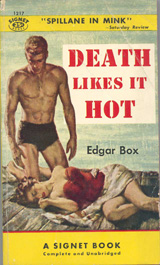
One of my rediscoveries is Gore Vidal’s three murder mysteries from the early 1950s featuring suave public-relations man Peter Sargeant (Vidal wrote them under the pen name Edgar Box) — Death in the Fifth Position, maybe the best backstage ballet murder mystery ever written; Death Before Bedtime, a maliciously funny evisceration of power, sex and corruption in the nation’s capital; and Death Likes It Hot, a mystery about — well, I can’t remember exactly, because I haven’t read it in a long time and I’ve just begun it again. But its first sentence is so delicious that I just have to take a cue from Rose City Reader and pass it along. (I can’t resist adding the second sentence, too, because it underscores the method of Vidal’s elegant wry comedy):
The death of Peaches Sandoe, the midget, at the hands, or rather feet, of a maddened elephant in the sideshow of the circus at Madison Square Garden was at first thought to be an accident, the sort of tragedy you’re bound to run into from time to time if you run a circus with both elephants and midgets in it. A few days later, though, there was talk of foul play.
Ah, the wonderful tastelessness of it all! Isn’t that what we long for in a comedy-of-manners murder mystery, even moreso than an alibi-proof plot?
And that got me thinking of my old friend and fellow ink-stained wretch Vince Kohler, who died too early, at age 53, several years ago, but not before creating his wonderfully seedy reprobate of an amateur sleuth, Eldon Larkin, an “overweight, oversexed reporter” on a daily newspaper in a mythical town on the southern Oregon coast. (Kohler, who when I knew him was a reporter for The Oregonian, where Berkeley escapee Eldon hoped a good scoop might someday land him a job, was once a reporter at the Coos Bay World.)
Every now and again somebody puts together one of those lists of Essential Books About Oregon That You Must Read Before You Drown, and they’re all very serious and pioneerish with a dash of Ken Kesey and Ursula LeGuin to prove they know a good yarn when they see one, but Vince’s Eldon Larkin mysteries never seem to get mentioned (although fellow gothic fabulist Katherine Dunn and her Geek Love do), and in an English and History department sense I guess I sort of understand but on the other hand it kind of saddens me, and I also think it might be a mistake. Because Vince, in the shabby person and jaundiced eye of the ever-yearning, ever-disappointed Eldon Larkin, captured so much of the soggy unsung essence of what old-line Oregon is all about — and he did it in a vulgar, overblown, cheesily entertaining style that’s easy to look down on until you try to pull it off yourself.
Plotting was the least of his worries, Vince once mentioned: He just figured out where he wanted the story to end, then worked backwards to see how he was going to get there. And it tended to be a wild reverse-gear ride. His first Eldon Larkin novel, Rainy North Woods, starts out (or ends up, in the reverse-plotting process) with a situation similar to Vidal’s in Death Likes It Hot, as Larkin discovers when a phone call interrupts his clam-chowder lunch at the waterfront greasy spoon:
Fiske, his editor, was on the line. “Some kinda Chinaman’s been stomped to death by an elephant at the circus –”
“I’m on my way,” said Eldon, feeling adrenaline heat his face.
Elephant squashes Chinaman! It was the craziest thing since the belly dancer who could eat glass. The craziest thing since he had received the notice in the mail from Berkeley that his divorce was final, two years ago.
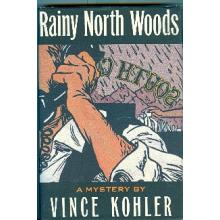 As things turn out, the “Chinaman” was a Vietnamese refugee, one of a large group who have settled up-bay in the years immediately after the war, and who live largely on their own, with only passing acknowledgement from the old-time fishermen, roustabouts, waitresses, druggies, teen-age moms and assorted hangers-on in this depressed and depressing corner of the nation. And as things turn out, the death was no accident: The elephant was hopped to its eyelids on drugs, and the murderer knew it was going to be frantic and confused enough to engage in a good stomping.
The violence in Rainy North Woods is comic-book gothic — the elephant gets winched up and hanged (very messy); a femme fatale gets a file shoved in her eye (very bloody) — but weirdly appropriate given the embarrassment of incident in Kohler’s tale. We get Bigfoot, UFOs, a smarmy Boy Scout, frat-boy drug runners, a lovelorn circus fat lady, a terrorized immigrant community, a long-lost silent movie star and lots more, some of it incidental flavoring, most of it part of the forest-thick tangle of the plot.
What impresses me, besides the tasteless fun of the thing, is how Kohler homed in on the quiet desperation and exultant looniness of our corner of the planet, a gothic lushness of dead ends and closed-mindedness that seems to sprout with the weeds in the rain. The sense of wet and misery can remind you of H.L. Davis‘s Honey in the Horn or Kesey’s Sometimes a Great Notion or the homeless lineups for lunch at the missions in Old Town. And I love Kohler’s ability to convey that even in a place as hidebound as Oregon, things change — and that the change comes not just from the suits in the corporate towers but also, and maybe more essentially, from the losers and escapees and newcomers and outsiders and roughnecks and oddball utopians who seem drawn to this place and sunk hip-deep into its wild fertile ground. The Vietnam vets, hiding in the woods and refighting their personal wars. The Asian immigrants, starting over in a befuddling place. The out-of-work mill hands, slowly realizing that times have changed. In Oregon we’re slow, but there’s at least a fighting chance we might get there, to some sort of accommodation with the outside world. In the guise of his diverting comic mysteries, Kohler had a feel for all that.
Vince wrote three more Eldon Larkin mysteries after Rainy North Woods, and they’re worth keeping an eye out for: Rising Dog, Banjo Boy, Raven’s Widows. Maybe they aren’t high lit. But long before the bumper sticker started showing up everywhere, they were pointing out how the strangest people keep Oregon weird.