The Culture Wars, version 2009: It’s beginning to look a lot like infighting

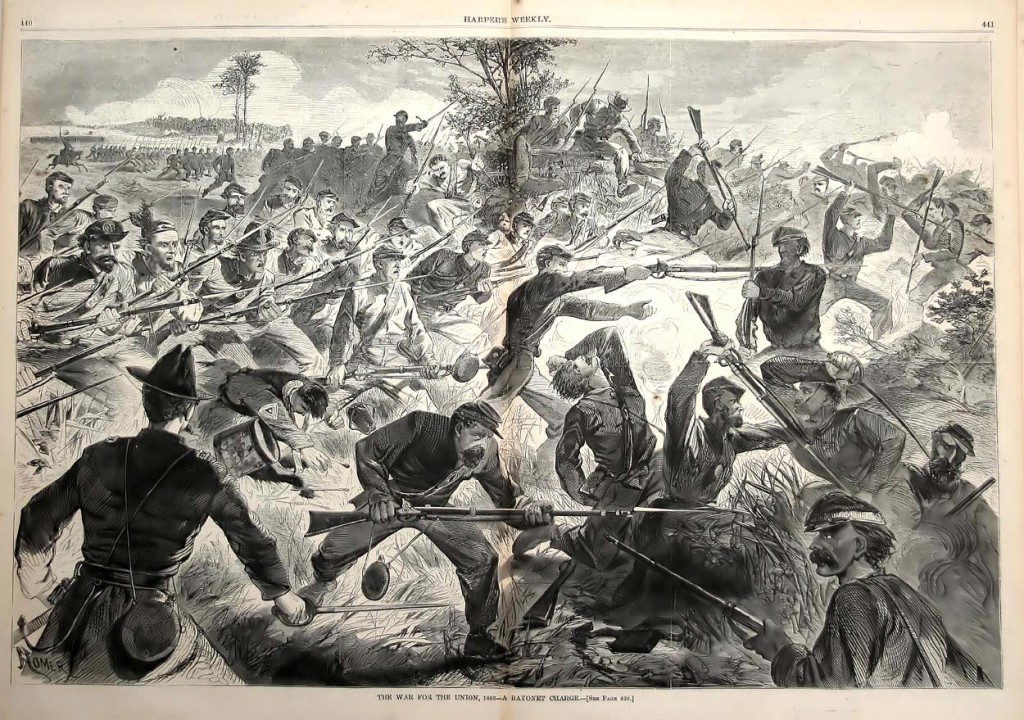
Winslow Homer, Bayonet Charge, Harper's Weekly, 1862/Wikimedia Commons

Rocco Landesman has barely been confirmed as new leader of the National Endowment for the Arts, and already it’s beginning to look like Bull Run.

To be fair, Landesman fired first.

We’re going to get away from this democracy-for-the-sake-of-democracy idea, he told the New York Times, and back to setting some good old-fashioned standards. No more spreading cash around just to be geographically correct. Money’s going to flow to quality — and that’s much more likely to be found in a big mainstream operation like Chicago’s Steppenwolf Theatre than in some little theater in Peoria.

Now the <100K Project (motto: “Bringing the Arts Back Home”) has fired back, branding Landesman as an anti-democratic elitist who equates art with money and power and who fundamentally misunderstands that art belongs to everyone. The post is worth reading, complete with comments.

It’s important to understand that these combatants, while they may be equally committed to the idea of art, are coming from very different places. The <100K Project is concerned with nurturing art in communities with less than 100,000 population: It believes that culture is everywhere, and has an intensely local base. Landesman is an urban high-roller, a big-deal Broadway producer who believes (and I hope I’m not putting false words in his mouth) that the best art and artists tend to accrue in large population centers — our New Yorks and Chicagos and the like — and are therefore the art and artists that must be kept flourishing. If “lesser” art sources in “lesser” places die in the process … well, that’s the price of ensuring quality.

It’s an old question, and always prone to pendulum swings. Who is art for? Is it participatory or inspirational? Do we travel to where it is, or bring it to where we are? There’s a history here: Too bad if you’re a Peoria or Portland and can’t afford the best. If you’re a Pendleton or Prineville, you’re not even in the discussion. The wealthy and otherwise privileged can travel to world cultural centers to experience the best. For the rest, well, there’s always TV. The abandonment of small towns and even medium-sized cities in the new economics is a social and cultural issue of real and under-discussed importance.

Yet quality IS an issue. We DO want to recognize that some things are better than others, and we do believe that those things should survive. So where are we: In a sectarian battle between big and small? Worrying about an issue that doesn’t exist? Jumping the gun on our ideas of who Landesman is and what he’ll do?

Oregon has consistently been treated as a colonial outpost in the national cultural game, as it has been in politics and economics. Even in the recent share-the-wealth days of NEA chairmen Bill Ivey and Dana Gioia, Oregon has had less NEA money returned to it than strictly statistical disbursement based on its share of the national population would dictate. One explanation (a pretty weak one) for that has been that money allotted to larger states can also be beneficial to smaller ones: Radio broadcasts of the Metroplitan Opera, for instance, that go to stations across the country.

Who’s right in this argument? Which way should the NEA go? Is it possible that both quality and geography can be served? Let’s hear your ideas.

17 Responses to “The Culture Wars, version 2009: It’s beginning to look a lot like infighting”

  1. Scott Walters Says:

    I’d like to say this: it is called the NATIONAL Endowment for the Arts, not the METROPOLITAN endowment for the arts. The NEA has a responsibility to support art EVERYWHERE in this country, not just a handful of so-called “arts capitals.”

  2. Ben Waterhouse Says:

    Also, Landesman should realize that the Met, with its massive fundraising capacity, has less need of NEA support than, say, Sojourn Theatre. The money also goes farther out here. $100k might sponsor a single performance by a New York company, but it could pay for an entire season by a midsize company out here.

  3. Trisha Mead Says:

    I’m torn. On the one hand, I LOVE his “stop apologizing for art” motif, which brings some much needed muscularity to a discussion that can easily be sidelined into metaphors like “the arts are like broccoli. Nobody likes them but they’re good for you.”

    On the other hand, I’m concerned in general about a northeast seaboard myopia that has been historically pervasive when it comes to the arts.

    It is interesting, of course, that he chose a second-city regional theater (and, interestingly, not the Guthrie) rather than a New York theater. To me this does not suggest that Portland gets wiped off the map in this new philosophy because of geography. It means that Portland companies will be evaluated on a par with equivalent organizations nationally (although without any geography based affirmative action going on). Which I don’t completely hate: I’m not sure I want to make the argument that money should come to use because our work is “pretty good….for Portland.”

    I firmly believe that our Portland-based arts organizations have the intrinsic merit and quality to stand up to the “Steppenwolfs” of the world.

    The question is, do we consider ourselves a community that has enough “creative capital” to be invested in for the quality of our work alone? Or are we suffering from our “not quite Seattle or San Fransisco” inferiority complex?

    If we are, we have much to fear in this new NEA philosophy. If however, we are prepared to be judged along side the Steppenwolfs of the world, we probably have some good hard PR work to do as a region to make sure that our geography is NOT a barrier to national perceptions of our quality.

    But then, we have that work to do anyway. Don’t we?

  4. Charles Deemer Says:

    How about a National Arts Lottery for spreading the money around? Would the national arts scene collapse as a result? I don’t think so. On the contrary I think we might see delightful surprises. Spread the money by a lottery and then get these metropolitan Critics to select the best for a funded national tour so everybody can enjoy the results. Two steps, then: the National Arts Lottery, followed by the National Arts Lottery Tour.

    Then we can save a lot of energy because we don’t have to argue about who deserves and does not deserve funding. Luck of the draw.

  5. Jonathan Owicki Says:

    Trisha: bravo! I think seeing this as an opportunity for the Portland performing arts scene to step up is right on the money.

    However, while Portland has the chance to compete on merit with Chicago and NYC theaters, I don’t think Pendleton and Prineville can. Rural Oregon(/America) shouldn’t be left out of the equation. Having some level of geographic awareness when it comes to funding isn’t so much about excusing inferior arts organizations as it is about helping otherwise disenfranchised communities experience art.

    I’ll admit that I’m biased as I am employed as a touring performer, but I think funding touring productions helps to close this gap. Touring theater allows the best companies to reach audiences who can’t come to them. It should be a part of the discussion.

  6. MightyToyCannon Says:

    I’m torn on the issue of how federal arts funding is best allocated. I keep coming back to this question: “What is the proper and unique role government should play in supporting the arts?” Presuming that art (at some level) will continue to be created without the investment of public dollars, how and where can public funding make the most difference? Should it be directed toward major institutions that achieve excellence and reach lots of people? Or should it act as an incubator for emerging arts groups that have less access to private sources of funding? Or should it help create access for folks who might otherwise not have it – i.e., the equivalent of investing in rural electrification?

    Former head of the NEA (98-01) Ivey is now running the Curb Center at Vanderbilt which considers cultural policy in a way that stretches beyond the traditional boundaries of nonprofit arts organizations into a broader sense of our “expressive lives.” How is that defined?

    “From the exhibitions we visit, to the videos we watch and make, to the clothes we wear; the choices we take about what culture to consume and what we create help us connect with others who share our opinions, ideas and beliefs. Through culture we find our place in the world; we explore who we are and who we want to be. This is our expressive life.”

    http://www.curbcentervanderbilt.org/

    Lots of thought food in all of this.

  7. Jane Says:

    I think we should invite Chairman Landesman out to the provinces for a look-see. I’d be delighted to have him hear a Third Angle concert.

  8. Trisha Mead Says:

    Apparently Peoria did just that. And Rocco said YES! Check it out: http://gratuitousviolins.blogspot.com/2009/08/yes-rocco-there-is-theatre-in-peoria.html

    And I believe Jonathon Owicki’s comment is very incisive- access to artistic and creative experiences in less accessible places should be a focus, not only of our national policy but also our local policy. When we abandon our rural areas culturally, we leave them prey to the worst excesses of demagoguery and impoverishment of spirit.

    The question would be, I guess, do we see nurturing creative culture across the barriers of our geography as a core role of our national funding mechanism? Or is the NEA’s role to feed the standard bearers, with the knowledge that their success feeds a long tail of smaller institutions throughout the country who can benefit from the new work, new methods, new ideas that are being created at the nations loftiest cultural institutions? Can we do both? Because if we can…let’s do THAT.

  9. MightyToyCannon Says:

    Ah yes, Trisha raises the “do both” strategy. We’re so accustomed to the arts getting short shrift that we let go of the dream of striving for multiple goals. So I say support the standard bearers who set the bar high while also nurturing the emerging artists and organizations and ensuring arts access broadly. Why not? Perhaps Mr. Landesman’s most important job will be to continually ask “why not?”

  10. Scott Walters Says:

    The NEA is not about you as artists. I know it is hard to get over the idea that it is all about you, but it isn’t. It is about the value of the arts to the general populace, and providing access to the American citizenry. This is a government agency, not a private patron who is investing in the future of your art production. It is about making sure that the arts are part of every American’s opportunities, because access to the arts is part of being an educated citizen, upon which a democratic society is based. To mask exclusivity as about the art itself masks the real question. Furthermore, like the SAT in education, Landesman’s idea of “qaulity” is actually more indicative of income than some intrinsic creative superiority. It means that Steppenwolf has more MONEY than a theatre in Peoria. By his reckoning, that means they deserve MORE money because they have a lot to begin with. It is a specious argument, one that lets the rich get richer — a Republican value system if there ever was one.

  11. Martha Ullman West Says:

    There was a time, my children, when the NEA had a site visitor program for the performing arts that sent critics (Charles Deemer, I don’t think you should dignify us by capitalizing the name!)and various other so-called experts, all over the country to look at what people were doing and then answer a questionaire about what we saw. I, in a period of about five years, went to the following places: Bozeman, Montana, Boise Idaho, Colorado Springs, Eugene, Oregon, Ft. Worth, Texas, New York City (they didn’t send me, I was there anyway, in case you’re worried about your tax dollars), watched good, bad, and indifferent dance, described it, answered questions about diversity (unh hunh), and responsiveness to the community in which the groups were performing. These days, the NEA can’t afford to send site visitors (we made really big bucks, huge, $100 for a report I believe and 24 hours of expenses paid and airfare if we weren’t there anyway)and I think the program is poorer for it. It evened the playing field for large and small communities, provided of course the site visitor had an open mind. And yes, I did recommend funding the Bozeman group, not of the first rank, but the only oppportunity for its citizens to see ballet. So here are some random thoughts–what we need is balance, and more than one perspective on just what that constitutes.
    I write from Connecticut where it is hot and humid and the Sound and trees looked as if they’d been painted by Watteau. cheers.

  12. Charles Deemer Says:

    Martha, I thought I was doing the opposite ha ha! In the tradition of Jonathan Swift.

  13. bob hicks Says:

    Well, this discussion’s going in interesting directions — thanks, and keep it up!

    A couple of thoughts. First, I believe Scott’s right that the value and responsibility of the NEA is toward the public, which argues in favor of a geographical, and maybe even anthropological, element to funding. (Although I’m not sure that necessarily means the discussion isn’t also “about” artists — after all, it’s artists who supply the art for the public’s good.)

    I also firmly believe that quality is a necessary element in decision-making. But what are the measures and assumptions of quality? Are they different in a town of 20,000 than in a city of 5 million? And are the SUBJECTS of art different in a rural community than in a large city? Put another way, are the standards/obsessions/fashions of New York necessarily the standards/obsessions/fashions of Cheyenne, and should they be?

    Localization is a legitimate issue, too; perhaps as important as quality — especially when quality is so open to interpretation. By the same token, I don’t want to get all sentimental about the verities of bedrock America. I’ve seen a lot of just plain banal art in small places that I’d be hard-pressed to justify supporting in any way with tax dollars (unless it’s maybe local tourism money, which comes out of a very different bag that presumably has very different purposes).

    It’s also important to recognize that if art is for “the people,” most of the people are concentrated in those urban areas that so much of rural and regional America mistrusts and sometimes loathes: I read recently that the 26 least populous states that account for a majority of representation in the U.S. Senate include just 18 percent of the country’s population. I don’t believe the small places should be left out — in fact, I believe it’s wrong on both practical and ethical grounds to do so — but HOW to divide things justly, and how to reconcile the needs and desires of small places (I don’t really mean Portland here; I mean, say, Klamath Falls and Baker City) with the judgments of the urban elite?

    I don’t know the answers, but I think the questions are essential. No matter how we slice the pie we’re going to get it wrong, but the object is to get it as close to right as we can.

    I think Martha’s right that site visits, for all their scrimping, provided a valuable service. I’m not sure they’re coming back, at least in the near future. I do think it’s essential that the NEA continue its block grants (as Richard Nixon called them in a similar context) to state and regional arts agencies such as the Oregon Arts Commission and the greater Portland area’s Regional Arts & Culture Council: In the absence of official site visitors those are the groups most likely to be able to make the tough calls to balance geography and quality.

    This is a very good time, after years of embattlement and circling the wagons against the onslaught of the cultural warriors, to take a sharp look at what we want and need from public arts funding; I hope that Landesman will bring a fresh eye and a willingness to take action to the process without assuming that anything that exists is probably wrong and ought to be changed just because it’s the way his predecessors have done things.

    Keep the thoughts coming!

  14. MightyToyCannon Says:

    Martha’s point about site visits reminds me that someone once opined that a important value of NEA, beyond the grants, is that its panel review process helps fosters a national dialogue about arts within peer groups. By bringing together peers from around the nation to review grants it has contributed to building networks of artists and arts administrators. I don’t know how much of that has diminished over the past two decades, but I’ll bet there’s less of it now.

  15. MightyToyCannon Says:

    Just spotted an interesting essay by Arlene Goldbard in reference to Landesman’s early verbal slips and his response. In the essay titled, “Playing Offense, Playing Defense at the NEA,” she describes Rocco’s short video address posted at the NEA site, saying “he drops the dog-whistle terms intended to ameliorate his prior offense: ‘arts education,’ ‘cultural vitality,’ ‘freedom of expression….’”

    She adds:

    “Then, oops!—’bringing the arts to all Americans,’ working ‘with our partners to help bring quality arts programs to neighborhoods and communities across the country.’ It’s possible he wasn’t aware of using the code-language of condescension again; you have to really understand cultural politics to perceive the difference between a missionary policy (bringing the best to the benighted) and one that embodies art’s democratic promise, the understanding that every community and every creator makes culture by infusing the raw materials of life with their gifts, everywhere life is found, money and prestige notwithstanding.”

    I realize that I’ve been guilty of “cultural condescension” (not to mention “cultural condensation”) when writing grants seeking funds to “bring the arts to underserved neighborhoods.” (By the way, if you’re a grant writer, make sure you never type “undeserved neighborhoods” by mistake. It’s almost as bad as writing about your “pubic programs” instead of those enjoyed by the “public”).

  16. Martha Ullman West Says:

    curiouser and curiouser. I raised this issue at a dinner party in Connecticut on Saturday night, attended by a gallery owner who shall remain nameless. She completely denied that Landesman had said what he’d said, or that it was condescending in any way. What she focused on was his implication that only the “artistically” deserving would get funded, seeming to think this could happen in Podunk as well as Peoria. But who decides I said plaintively…no one had an answer for that one. I hate hearing that he’s using now those buzzwords quoted above by MTC, and dare I suggest that the arts in fact are not democratic, that artistic excellence has some form of elitism written all over it, but that does not necessarily mean that there can’t be a certified genius of paint, or pointe work, or song, or pottery if it comes to that in Drain, Oregon.

  17. Martha Ullman West Says:

    And this is for you Charles Deemer–my father, who was a painter and sculptor, used to say there are men, there are apes, and down the evolutionary scale, critics, or Critics, as the case may be. I try to be a humble critic; I’m certainly ambivalent about the value of anything we do.

Leave a Reply

a Portland-centric arts and culture blog