Art Scatter’s indefatigable chief dance correspondent Martha Ullman West, fresh from a sojourn in the Big Apple, hit the ground running on her return to Portland. In a week and a half she took in the Northwest Dance Project’s fall show, White Bird’s presentation of the Hofesh Shechter Company, Jim McGinn and Carla Mann’s “Exquisite Corpse,” and Imago Theatre’s teetering version of Jean-Paul Sartre’s “No Exit.” Herewith her report on her adventures:
**********************************************
In the past 10 days I’ve witnessed four performances, three of them easily classified as dance, the fourth, if we must be Aristotelian about this, as physical theater.
For my New York colleagues this would have been a light schedule. For me it was pretty packed.
Not that I’m complaining — it’s terrific, particularly in these times, that we get to see so much performance in our town. Portland artists are brave and bold, even when the work may not be, and White Bird continues to provide us with dance that ranges from the phenomenal (Baryshnikov and Ana Laguna) to the intriguing (Hofesh Shechter).
Let us begin with the Northwest Dance Project, which I attended opening night at the Newmark, on Friday the 16th. In a pre-curtain speech, executive director Scott Lewis stressed the importance of presenting new work, pointing with considerable pride to a program made up entirely of “world premieres” — a term which, like “world class” and pre-curtain speeches themselves, I wish would get lost in the stratosphere.
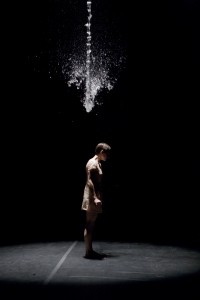 His pride in Dance Project artistic director Sarah Slipper’s new work, Not I, is justified. While I wish I had known when I was watching Andrea Parsons perform this very demanding and emotion-laden solo that the monologue she was dancing to was the uncredited Samuel Beckett’s — and while the video monitor on stage was a bit too reminiscent of Bill T. Jones’s controversial Still/Here, which also dealt with bodies raddled by illness and minds sinking into dementia — Slipper’s jitter-laden, despairing movement has stayed with me. And it’s passed this sure test: I’d like to see it again. Moreover, it was the only piece on this program that had a discernible beginning, middle and end.
But new does not necessarily mean good. Nor, necessarily, bad. Except for Not I, the work commissioned for this concert ranged from the mediocre to the ordinary. There were moments in the second part of Edgar Zendejas’s Bu Ba Bee when I began to hope he was going to make use of the energy of the dancers in this young company, and he did create a quite fine solo for Patrick Kilbane. But nobody moved much in the three-part work, and what’s more, I never did figure out what any of them was about, or their relationship to each other.
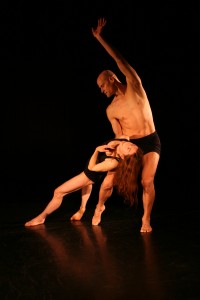
Benoit-Swan Pouffer’s Almost Twelve featured the inevitable male-bonding and many sculptured poses. In nearly all the work I saw — including Hofesh Schechter’s and Exquisite Corpse, Carla Mann and Jim McGinn‘s handsomely executed evening of duets at Reed College created by themselves, Seattle’s Mary Sheldon Scott, Tahni Holt and Rumpus Room’s Stephan Laks and Rachel Tess — Rodin’s larger-than-life naturalism seemed to provide a leitmotif. Personally, I’d rather see dancers move than pose, especially when they have the youthful energy of the Northwest Dance Project’s. Andrea Miller’s Lewis Park, which concluded that sturm-laden program, at least had some cheerfully colorful costuming, but the lack of craft in that piece and Pouffer’s (these are choreographers who have something of a reputation) made me wonder if they had just tossed something off for the benefit of the provincial audience.
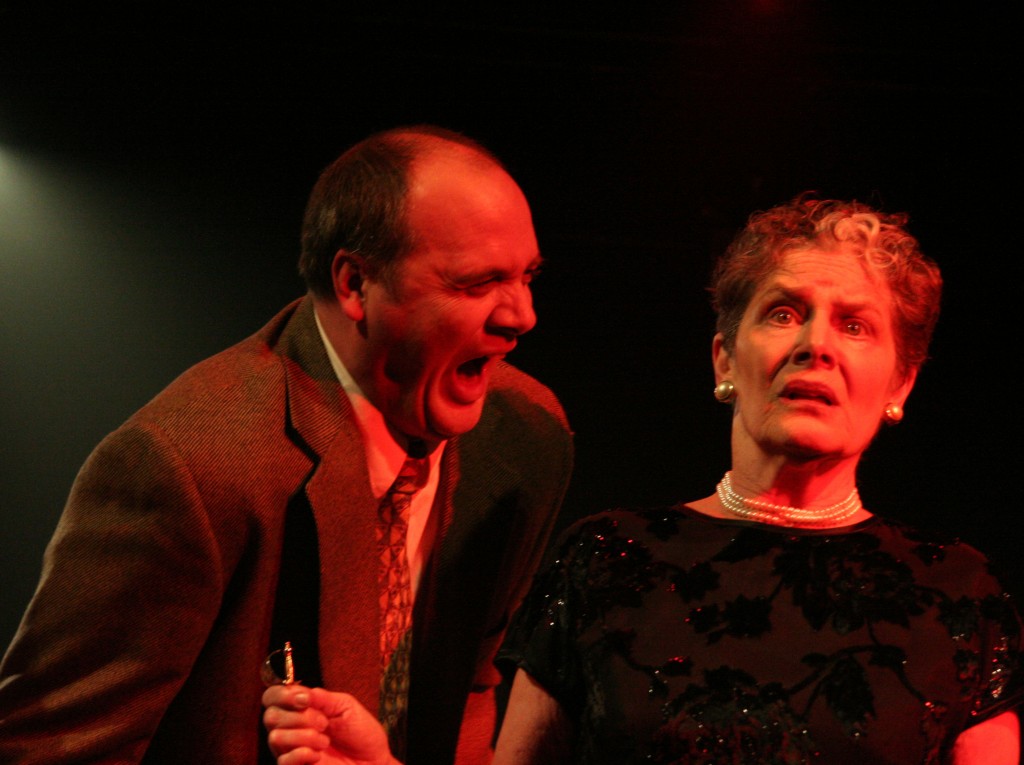
 Craft, however, came to the fore in Imago’s revival of Sartre’s No Exit, which I saw the next night. In Jerry Mouawad’s humor-laden version of what was originally an exceedingly grim and cynical play, existentialism meets surrealism — particularly in the tilting platform, portrait bust (decidedly not by Rodin) and three small couches that constitute the set. De Chirico, I thought, the minute the lights went up. And Thomas Mann, I thought again, as the Valet, dressed as a bell hop, ushered Garcin into the room.
Why Mann? The Confessions of Felix Krull, Mann’s last and unfinished novel — and the only one, for my money (not that I’ve ploughed through all of them, by any means) that’s even faintly amusing. The cast is just plain terrific, very experienced, and it showed. Bryce Flint-Somerville as the Valet is a sinister, relentless tease. Tim True’s Garcin is the personification of intellectual despair, a man who would like to escape into sleep, but it’s Sartre’s vicious idea that there is no sleep in Hell. JoAnn Johnston’s Inez is equally an intellectual performance of a world-weary woman with a chip on her shoulder and a yen for other women (Sartre doing a number on Simone de Beauvoir); and Maureen Porter plays a narcissistic, self-serving woman consigned to Hell for murdering her baby.
Costumes, fabulous costumes, are part of this mix — the women’s elegant gowns are easy to move in, even on that tilting platform — and music provides some truly hilarious touches: the Valet walking around the outside of the platform to the beat of When the Saints Go Marching In. There’s still plenty of time to see No Exit. Do.
Of Hofesh Shechter, The Oregonian’s Marty Hughley has pretty much said it all. My own take is close to his: I found the second piece much too long and I loved the music for all of it. I would add that as the curtain went up on Uprising to reveal enough stage fog to conceal the activities of Jack the Ripper and a bar of bright lights glaring at the audience, for a terrible moment I thought the company was going to do a version of James Canfield’s Relief of Mass Hysteria. Happily, Uprising bears no relationship to that MTV ballet, and as a showcase for the phenomenal male dancers in Schechter’s company it’s pretty terrific.
In both pieces, I thought the ensemble choreography was consistently more interesting than the few solos and duets, and I much admired Shechter’s fearlessness in juxtaposing stillness against explosive activity. Like most young artists of any discipline, Shechter needs to learn to edit. I suspect that will come in time.
PHOTOS, from top:
- Tim True and JoAnn Johnson in Jean-Paul Sartre’s “No Exit.” Photo: Jerry Mouawad/Imago Theatre
- A cascade of water soaks Andrea Parsons in Sarah Slipper’s “Not I.” Photo: Blaine T. Covert
- Carla Mann and Jim McGinn in “Exquisite Corpse.” Photo: Gordon Wilson